Claude for Teachers Is Here: What Anthropic's New AI Means for Schools and Parent Communication

Anthropic has launched Claude for Teachers, a free version of its Claude AI built specifically for educators. Announced on 14 July 2026, it gives verified K-12 teachers in the US free access to premium Claude features, a library of teaching skills grounded in learning science, and lesson materials aligned to academic standards in all 50 states. Teachers can sign up through 30 June 2027 for a full year of access.
For schools, it's the clearest sign yet that AI is moving into the teacher's daily workflow, planning, differentiating, analysing data, and it raises a practical question every school should ask: once AI helps a teacher draft the message, where does that message safely reach parents?
Here's what you'll learn:
- What Claude for Teachers is and who can use it
- The features teachers get, from lesson planning to data analysis
- How Anthropic is handling privacy and student data
- Why it's US-only for now, and what that means for schools elsewhere
- Where a secure, official channel still fits once AI drafts the message
What is Claude for Teachers?
Claude for Teachers is a free, education-specific version of Anthropic's Claude assistant, launched on 14 July 2026. It's available to verified K-12 educators in the US, free of charge, with sign-ups open until 30 June 2027 for a full year of access. Access is limited to educators, in line with Claude's 18+ policy, not students.
Anthropic's framing is that the tool supports real instructional practice: differentiation, mastery-based learning, and standards-aligned planning, rather than being a general chatbot bolted onto the classroom.
What can teachers actually do with it?
Verified teachers get premium Claude capabilities plus tools built for teaching:
- A library of teaching skills grounded in learning science.
- Standards-aligned planning through a connection to Learning Commons, which brings in academic standards across all 50 states.
- Differentiation: adapting the same material for students at different readiness levels.
- Lesson planning with scaffolding, data analysis, and automated task scheduling.
- Claude Code and Cowork for more autonomous, multi-step work.
- Integrations with nine K-12 tools, including ASSISTments, Brisk Teaching, and Canva Education.
Anthropic also worked with curriculum and education partners, including OpenSciEd, Illustrative Mathematics, Teach for America, and the American Federation of Teachers, to ground the tool in classroom reality.
What about privacy and student data?
Anthropic has put data protection front and centre. Teacher conversations are not used to train its models, training is off for verified teacher accounts, and student information is covered by a K-12 Data Processing Addendum written to comply with FERPA, the US student-privacy law. The company partnered with the American Federation of Teachers on safety standards, and piloted the tool with Prospect Schools in Brooklyn, with further evaluation planned in Detroit Public Schools.
That emphasis is a signal in itself: as AI enters the classroom, data privacy is the price of trust, a standard schools should hold every tool to, not just the AI.
Why it's US-only, and what that means for schools elsewhere
For now, Claude for Teachers is limited to verified US K-12 educators. Teachers in the GCC, the wider Arab world, the UK, and East Africa can't sign up yet. The launch is part of a broader race, with OpenAI, Microsoft, and Google all pushing into classrooms, so region-by-region expansion is likely, but there's no MENA availability today.
For schools outside the US, the takeaway isn't to wait. It's that AI in teaching is arriving fast, and the smart move is to get the surrounding infrastructure right now, especially the channel that carries communication to families.
What it means for schools: AI drafts, but communication still needs a secure home
Here's the practical gap. Tools like Claude for Teachers make it faster to produce things: a lesson plan, a differentiated worksheet, a parent update, a progress summary. But producing a parent message isn't the same as delivering it safely to the right family, on the record, in a language they understand.
That last mile is exactly what Schoolvoice is built for. Schoolvoice is a school's official, private communication and engagement platform, the secure channel a message actually goes out on, whether a teacher wrote it themselves or drafted it with AI:
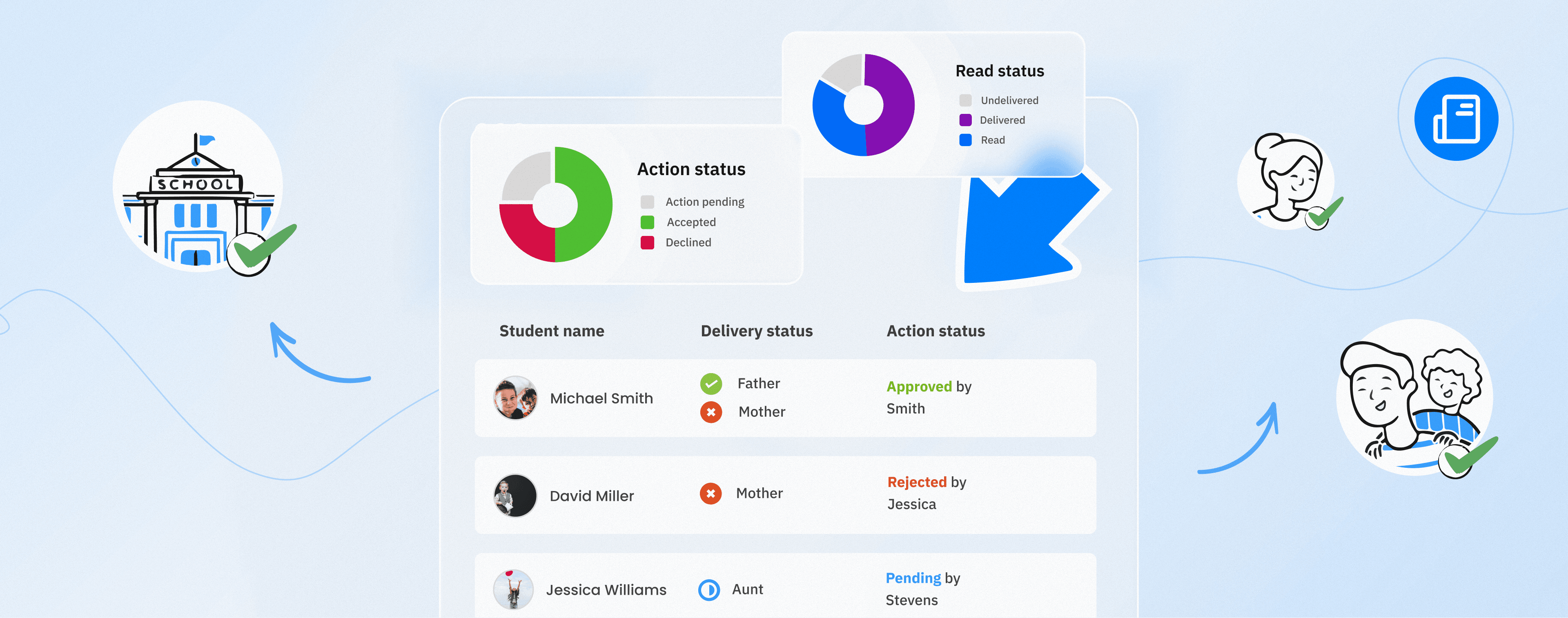
- Its own AI, where it counts. Real-time AI content moderation keeps chat safe, in-chat message translation reaches parents in their own language, and engagement reporting shows which families actually saw and acted on a message.
- Privacy by design. No personal phone numbers are shared, every conversation stays on the school's official channel, and there's a full audit trail, the same data-protection instinct Anthropic is leaning on, applied to school-parent communication.
- Built for this region. While Claude for Teachers is US-only, Schoolvoice is built for Middle Eastern schools, with an app in 8 languages and localisation the US-built tools don't have.
Think of it as a division of labour: let AI help teachers plan and draft, and let Schoolvoice carry the official communication to parents, securely, in the right language, with proof it landed.
If you're weighing how AI fits your school's workflow, start with the channel families actually rely on. Book a demo and see how Schoolvoice keeps parent communication secure and on the record.
The AI shift in schools is also why regional rules are tightening, see the UAE's recent social media ban for under-15s. The schools that come out ahead pair new tools with a trusted, official channel.
Schoolvoice is free for schools to start. Book a demo to see it in action.
References
- Anthropic, "Introducing Claude for Teachers" (14 July 2026): anthropic.com
- The Hill, "Anthropic launches free Claude for Teachers": thehill.com
- EdSurge, "Anthropic Introduces Claude for Teachers": edsurge.com