UAE Social Media Ban for Under-15s (2026): What the New Law Means for Schools and Parents

The UAE has set 15 as the minimum age to use social media. Under Cabinet Resolution No. 106 of 2026, announced by the UAE Government Media Office on 18 June 2026, platforms such as TikTok, Instagram, Snapchat, Facebook and X must keep under-15s off their services, verify every user's age, and apply extra protections for 15- and 16-year-olds. Platforms have a 12-month window to comply.
For schools, the takeaway is direct: consumer social media is no longer a place to reach younger students, and the schools that already run parent communication through an official, private channel are the ones ahead of the change.
Here's what you'll learn:
- What Cabinet Resolution 106 of 2026 actually says
- How platforms will verify a child's age (and why "just type your birthday" is over)
- Who enforces the law and what the penalties are
- What the ban changes for how schools reach students and families
- How to communicate with parents through an official channel that isn't social media
What does the new UAE social media law say?
The core rule is simple: the minimum age to use social media in the UAE is now 15. Children under 15 are barred from holding accounts and from the full features of social platforms: social interaction, publishing, commenting, sharing, and joining public groups. Social media companies are required to detect and disable accounts belonging to under-15s.
Teenagers aged 15 to 16 may use social media, but only with enhanced protective measures, such as content restrictions and limits on usage time.
The resolution names the major platforms it applies to, TikTok, Instagram, Snapchat, Facebook and X, and gives them a 12-month compliance period to put the required systems in place. The measure sits within the UAE's wider child digital-safety agenda, aimed at protecting minors online rather than policing families.
How will platforms verify a child's age?
This is the part with teeth: simply typing in a date of birth will no longer be accepted. Platforms must use one or more approved, robust age-verification methods:
- Government or official ID verification: digital identity checks, official document scanning, or biometric matching such as facial recognition.
- AI-based age estimation: artificial-intelligence techniques, including biometric methods.
- Licensed third-party providers: age-verification services officially approved to operate in the UAE.
- Council-approved methods: any additional approach cleared by the Child Digital Safety Council.
Whichever method a platform picks, the systems must be accurate, collect the minimum data necessary, comply with data-protection principles, remain non-discriminatory, integrate with national systems, allow regulatory audits, and stay transparent to users.
One detail matters for parents: parental consent is not a valid exemption. A guardian cannot sign off to let an under-15 keep a social media account. The age floor is the age floor.
Who enforces the law, and what are the penalties?
Oversight sits with the Telecommunications and Digital Government Regulatory Authority (TDRA) and the Child Digital Safety Council. Regulators have broad authority to act against platforms that don't comply: from formal warnings, to partial or full blocking of a platform in the UAE, to administrative penalties.
In practice, that means the named platforms have a firm deadline and real consequences, and the responsibility for keeping under-15s off social media sits with the companies, not with individual families.
What the ban means for schools
For schools, the ban closes off consumer social media as a way to reach younger students, and shifts the spotlight onto how the school communicates with their families instead. Plenty of schools quietly rely on those platforms to reach their community: an Instagram page for announcements, a Facebook group for a year cohort, a TikTok for school life, WhatsApp broadcasts for the daily flow. For the under-15 student population, that ground is now shifting.
Two things change at once. First, the students themselves can't legally be on those platforms, so anything aimed at them can't route through social media. Second, the spirit of the law is child protection, and a school seen nudging families toward consumer social apps looks out of step with the direction the UAE is setting.
What schools need is what many have wanted anyway: an official, private, age-appropriate channel that isn't a social network, one that reaches parents reliably, keeps students' data protected, and gives the school full control and a clear record.
Why Schoolvoice is the official, non-social channel schools need
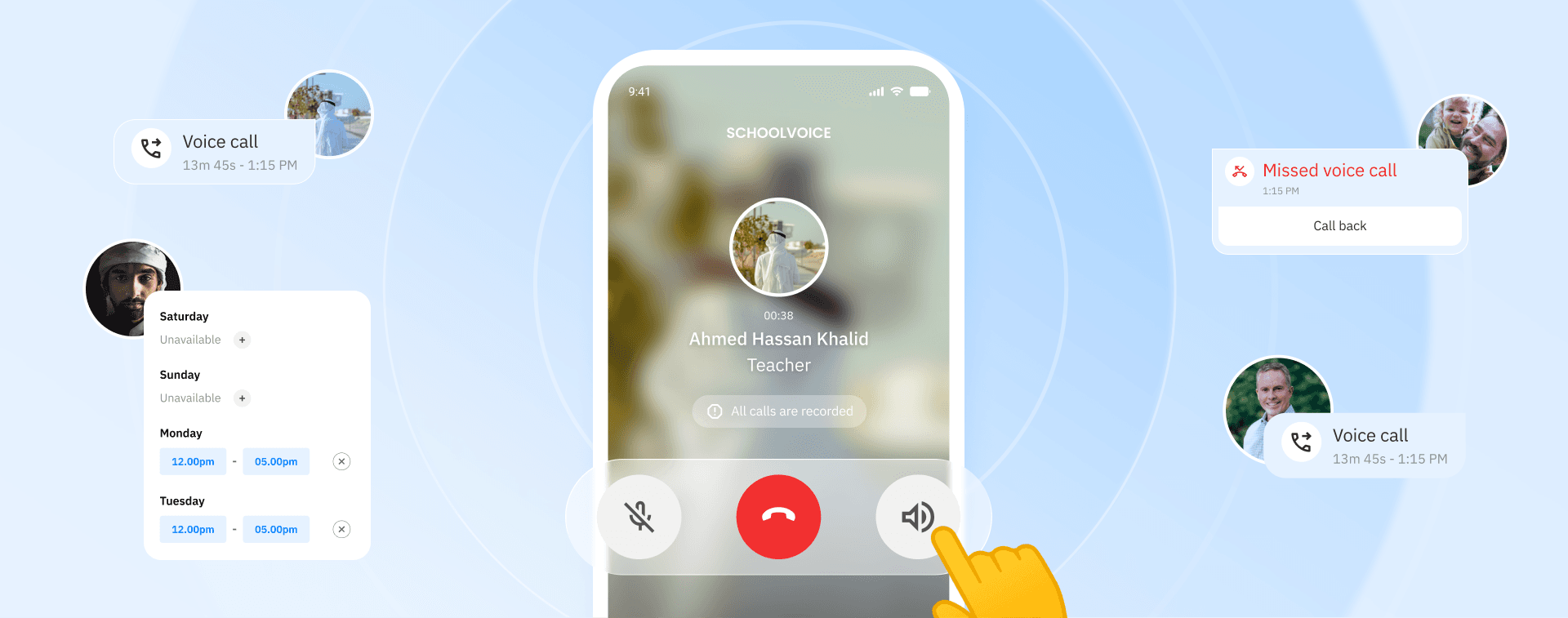
Schoolvoice is a private, school-owned communication and engagement platform, not a social network, built to be a school's official channel to families. That makes it a natural fit for a UAE moving decisively on child digital safety: a closed, controlled channel a school runs itself, rather than a public platform it doesn't.
Where consumer social media exposes children to a public feed, Schoolvoice is closed and private by design:
- No public exposure. Schoolvoice Stories share class moments Instagram-style, but the audience is strictly limited to a student's authorized guardians, posts auto-expire after 24 hours, and content is AI-moderated. There is no public profile, no open comments, no strangers.
- Privacy by design. Parents and teachers communicate without ever exchanging personal phone numbers, chat is AI-moderated in real time, and schools keep a full audit trail, the opposite of an open social platform.
- Guardian-first, school-controlled. Communication reaches parents on an official channel; where a school enables student access, it stays fully under the school's control, not a consumer account on a public network.
- One official channel instead of scattered social groups. Schoolvoice consolidates the Instagram-page, Facebook-group and WhatsApp-broadcast sprawl into one branded, secure parent communication app, with one-tap approvals, payments, and read-and-action reporting so nothing gets lost.
If your school has been leaning on social media or WhatsApp groups to reach families, book a demo and see how Schoolvoice replaces them with one official, private channel.
The under-15 ban is one of several recent UAE moves reshaping how schools operate, alongside changes like the 2025-2026 attendance and absence policy. The schools that adapt fastest are the ones that already own their channel to parents rather than borrowing someone else's.
Schoolvoice is free for schools to start. Move your parent communication onto the official channel, book a demo today.
References
- UAE Government Media Office / WAM, via Arab News, "UAE sets minimum social media use age at 15" (18 June 2026): arabnews.com
- Gulf News, "UAE Social Media Ban for Under-15s: New Age Verification Rules Explained": gulfnews.com
- Emirates 24|7, "UAE bans social media for children under 15, sets age verification rules and 12-month compliance period": emirates247.com