ADEK Parent Engagement Policy: The Compliance Checklist

Every private and charter school in Abu Dhabi is bound by the ADEK School Parent Engagement Policy, and the deadline for full compliance has already passed.
Schools were required to meet every requirement from the start of the AY 2025/26 Fall term. So the policy is no longer a deadline to prepare for. It is a standard you are held to today. Several of its requirements also reset each September, as families re-enrol for the new year.
This checklist gathers every requirement in the policy, ordered by what your school actually has to do rather than by clause sequence. It also flags the requirements schools most often cannot evidence when asked.
It is a practical summary written for school teams, not the policy itself. Use it to work through your own compliance, and keep ADEK's published document as the version you cite.
In this article
- What the policy is, who it covers, and which version is current
- Documents you must hold and republish every year
- The staff parents must be able to reach
- Information you must send, and when
- Consents you must collect and keep records of
- Mandatory structures, including a parent council
- Three communication rules with no threshold and no exemptions
- Where schools fall short, and what evidence actually proves compliance
What is the ADEK Parent Engagement Policy, and who does it cover?
The policy sets the minimum standard for the partnership between Abu Dhabi schools and families, treating parents both as partners in their child's learning and as members of the school community.
It applies to all private and charter schools in the Emirate of Abu Dhabi. It supersedes earlier related circulars, and any later circulars issued specifically for charter schools.
| Current version | Version 1.2, issued November 2025 |
|---|---|
| Effective from | AY 2024/25, Fall term |
| Full compliance required from | AY 2025/26, Fall term |
| Scope | Private and charter schools in Abu Dhabi |
| Non-compliance | May result in legal accountability and penalties under ADEK regulations, alongside penalties stipulated in Federal Decree Law No. 31 of 2021 |
Two things are worth knowing about the current version. Version 1.2 replaced version 1.1 in November 2025, and the change was narrow.
Clause 3.2.2 now references the ADEK School Food and Nutrition Policy, after that document was renamed from the Healthy Eating and Food Safety Policy.
Clause numbering, dates and the other obligations did not change. So if your compliance file still cites the policy's former name, it needs updating.
Worth knowing if your team works in Arabic: the Arabic version ADEK publishes is still version 1.1, issued September 2024, while the English is version 1.2. Clause numbering is identical across both, so any reference here applies to either.
The policy has four main sections:
- The parent-school agreement
- The parent handbook
- Parent engagement
- Compliance
1. Documents you must hold and republish every year
The parent-school agreement: clause 1.1
Every parent must sign the agreement before their child is enrolled, then sign it again annually on re-enrolment.
A common gap appears here. Many schools treat the agreement as an admissions step completed once, while the policy requires it to be renewed with each academic year.
The agreement must set out the obligations of both the school and the parent, and require the parent to accept the school's policies in full. It must also include the parent code of conduct and an acknowledgment of the student code of conduct.
The parent code of conduct: clause 1.2
The policy specifies 13 items as the minimum the code must contain. They include:
- Respect for the school's values
- Professional treatment of all staff, including security and cleaning teams
- Shared responsibility for student wellbeing
- Responsible conduct on social media
- Support for attendance and punctuality
- Respect for academic integrity
- Responding to meeting requests
- Cooperating with additional learning support recommendations
A school may deny a parent access to its premises if they disregard these obligations.
The parent handbook: clause 2.1
The handbook must be published on the school website at the beginning of every academic year, and must include a blank copy of the parent-school agreement.
The policy specifies its contents:
- Admission and enrolment
- Tuition fees
- Uniform
- Daily schedule
- Attendance and punctuality
- Behaviour
- Academics
- Curriculum
- Assessment
- Communication protocols
- Nutrition
- Student protection and welfare
- Transportation
2. The staff parents must be able to reach
Clause 3.1.1 is more specific than many schools expect. It does not simply ask for communication to be available. It names the staff a parent must be able to contact directly.
Your child's teachers: clause 3.1.1.a
Parents must be able to contact their child's teachers to follow up on academic progress.
Additional support staff: clause 3.1.1.b
Parents must also be able to reach every staff member planning or already providing additional support for their child. The policy names explicitly:
- The Inclusion Assistant
- The Counselor
- The Social Worker
Proactive contact: clause 3.1.1.c
Teachers and educators must initiate contact with parents when there is an academic or behavioural issue to discuss.
This is an obligation to take the initiative, not to wait until a family asks.
Reminders of response times: clause 3.1.1.e
Schools must send regular reminders of expected staff response times during working hours, and provide alternative contact information for emergencies.
Stating response times once in the parent handbook is not enough. Families have to be reminded regularly.
3. Information you are required to send
Section 3 spreads communication duties across learning, wellbeing and school life. Ordering them by what triggers them makes the picture clearer.
Sent on a schedule
Student performance reports: clause 3.1.5
Reports must be shared in digital format, with an opportunity to meet teachers at least once every term.
Curriculum and learning information: clauses 3.1.2 and 3.1.6
Parents must receive information on the curriculum, the expected learning outcomes for the year, and strategies that help them support learning at home.
Assessment guidance: clause 3.1.3
Guidance must be provided through direct communication, workshops or training sessions.
The school calendar: clause 3.3.10
The calendar must be shared as soon as ADEK approves it.
The ECA calendar: clause 3.2.5
Schools must share the extracurricular calendar, along with the documents and systems parents need to register their children.
The open day: clause 3.3.1
At least one open day must be held each year, letting parents visit their child's learning spaces.
School bag weight: clause 3.2.10
Regular reminders must be sent about the approved limits for school bag weight.
The inspection rating: clause 3.3.6
The school's inspection rating and report must be published on the school website.
Sent when something happens
Food-related concerns: clause 3.2.2
Parents must be informed of any food-related concern on the same day it was noticed, without deferring it to the next day.
Counselling needs: clause 3.2.3
Parents must be informed when a counselling need is identified for their child, with the confidentiality and consent implications explained.
Additional learning needs: clause 3.2.4
Parents of students with additional learning needs must receive progress updates, and be told of any fees beyond the school's standard inclusive provision.
Student protection notifications: clause 3.3.9
These notifications cover:
- Access passes
- Authorisations for unaccompanied Cycle 3 students
- Arrival and departure notifications
- Pre-registration of guests
- Changes to pick-up arrangements
Transport information: clause 3.3.11
Schools must explain bus services, drop-off and pick-up protocols, authorised persons, and parking arrangements.
Licence suspension, reinstatement or closure: clause 3.3.13
Parents must be informed of these decisions once they are finalised.
Two-way, not broadcast
Wellbeing surveys: clause 3.2.1
Schools must run parental surveys that give families a route to feed back on their child's wellbeing.
Planning your child's education: clause 3.1.2.a
Parents must be engaged as equal partners in planning their child's education, including placement and support decisions.
Changing curriculum: clause 3.1.4
Families seeking to switch curricula must be guided, with the impact on continuity of learning explained.
School fees: clause 3.3.5
Schools must enable parents to pay ADEK-approved fees in a timely and convenient way, without charging VAT.
Schools must also explain how they respond to late payment or non-payment.
4. Consents you must collect and keep
Consent requirements sit in four different places in the policy, which is why they are easy to miss if treated as a single step.
Photography and video: clause 3.2.6.b
Written consent must be obtained from the parent before photographing or recording a student.
Transferring student data: clause 3.3.7
Parent consent must be obtained before transferring student information to any third party, when a student moves to a school inside or outside the UAE.
Declining UAE equivalency: clause 3.1.4
A signed undertaking must be obtained from parents who choose not to seek equivalency in the UAE.
Placement and support decisions: clause 3.1.2.a
Consent must be obtained wherever placement, pull-out or push-in support decisions require it.
Clause 3.3.7 adds two further obligations:
- Parents must receive a copy of any report on student information submitted to ADEK.
- Parents may access their child's school records on request.
5. Structures your school must establish
Clause 3.3.4 turns parent voice into part of school governance. Its wording is mandatory, not advisory.
Your school must have:
- A Governing Board including at least one parent representative with voting rights
- At least one parent representative per grade or year, acting as liaison between teachers and families
- A committee representing the parent community, in whatever form the school chooses: an advisory council, a parent council, or a PTA
The text gives schools no way to skip this. A school without a parent council must employ strategies that encourage families to form one.
Once formed, the school must actively support and partner with it. Parent representatives are expected to represent the whole parent body, not their own children's interests.
Related obligations sit in neighbouring clauses:
- Encouraging parent volunteering, after PASS registration and the required security clearance, per clause 3.3.2
- Encouraging attendance at school events, per clause 3.3.3
6. Three communication rules with no threshold
Clause 3.4 contains three direct operational rules. They describe infrastructure the school must have, not intentions it declares.
3.4.1: Multiple channels, and accessibility
Schools must communicate with parents through multiple means, including:
- Newsletters
- Telephone calls
- SMS
- Letters
- Internet portals
- Meetings
Schools must also consider the accessibility needs and preferences of parents in how they receive and read communication.
Clause 3.3.12 reinforces this, requiring equitable access for parents of students with additional learning needs, and for parents who are themselves people of determination.
3.4.2: A mass notification system
Schools must have a mass notification system that lets them reach parents quickly in an emergency. It may be:
- A text message system
- A public address system
- A mobile app
The requirement is plain: either the school has a working mass notification system or it does not.
3.4.3: A record of all written communication
Schools must keep a record of every form of written communication with parents.
Read the wording closely. It sets no minimum number of messages, restricts the record to no particular category, and exempts no informal channel.
If a written message went to a parent, it falls within the record you are required to keep.
Where do schools most often fall short?
From our work with schools across the UAE, the gap is rarely knowledge of the policy. School leaders know what the document asks for.
The gap is the ability to produce evidence.
Four requirements are harder to prove than the rest, and they tend to expose weaknesses in process once records are requested.
1. The complete communication record: clause 3.4.3
A school that spreads communication across WhatsApp groups, personal staff numbers, printed letters and email cannot produce one complete record.
The messages may exist, but they are scattered across personal devices and accounts the school does not control.
When a teacher leaves, the portion held on their phone or personal accounts can leave with them.
2. Proof of consent: clauses 3.2.6.b and 3.3.7
Knowing that a parent gave consent is not enough. The school must be able to prove:
- When consent was given
- Which parent gave it
- What purpose it covered
Consent collected on paper forms is often hard to retrieve per student on request.
3. Reach, not just sending: clauses 3.4.1 and 3.3.12
A message sent through a channel some families cannot use does not satisfy the accessibility requirement.
The school needs to know which families communication actually reaches, not only which messages were sent.
4. The annual reset: clauses 1.1 and 2.1
Agreements signed once at admission, and handbooks published one September then never republished or updated the following year, are among the most common forms of silent failure.
What does good evidence look like?
Test each requirement with a simple question: if an inspector asked for evidence today, what would you show them, and how long would it take to produce?
| Requirement | Evidence that satisfies it |
|---|---|
| Written communication record, clause 3.4.3 | An exportable log of every message showing recipient, date and time sent, and delivery status |
| Response time reminders, clause 3.1.1.e | Dated reminders actually sent to parents, not a paragraph published in the handbook |
| Photo and video consent, clause 3.2.6.b | A per-student record showing which parent gave consent and when |
| Data transfer consent, clause 3.3.7 | A retrievable consent record for every student who transfers |
| Digital performance reports, clause 3.1.5 | Delivery confirmation per student, per term |
| Food-related concerns, clause 3.2.2 | Timestamps proving the message reached the parent the same day |
| Mass notification, clause 3.4.2 | A system that exists and has been tested, backed by reach data |
| Accessibility, clauses 3.4.1 and 3.3.12 | Proof of the language options available, and data showing which families are actually reachable |
The pattern is clear. Most requirements are proved by a timestamped, exportable record, not by wording in an internal policy.
How the right communication channel makes compliance provable
The policy does not mandate any particular software or platform. A school can meet its requirements through careful, disciplined paper processes.
What software changes fundamentally is the time it takes to produce the evidence.
When parent communication runs through one official channel, several requirements become reports you can export on demand.
The written communication record
The record is kept automatically, with delivery and read status for every message, exportable as PDF or CSV.
Documented consent
Consent is captured as a documented action carrying the parent, the timestamp and the decision, with the parent authenticating by PIN.
Measuring reach
Reach becomes measurable instead of assumed.
On average, schools reach about 86% of parents through Schoolvoice, and many reach 100%.
Mass notification
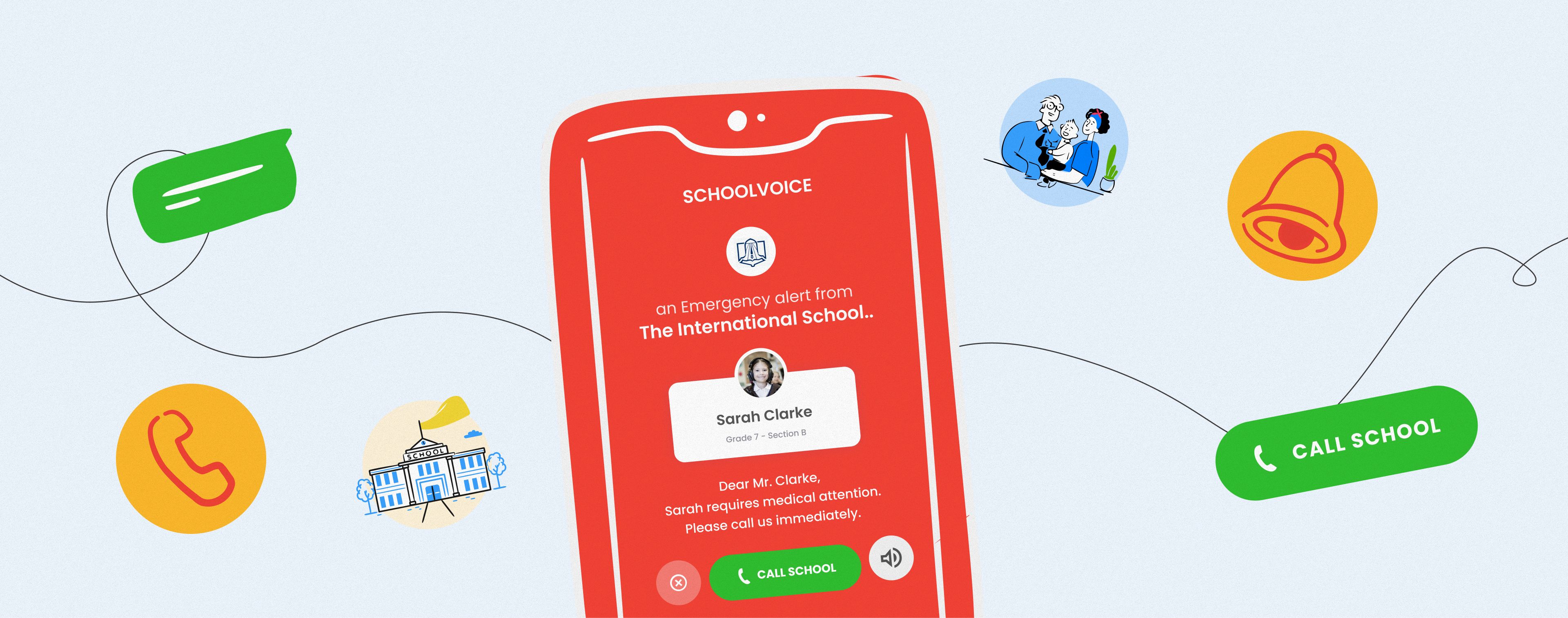
Mass notification is built into the Schoolvoice platform.
Clause 3.4.2 names text messaging, public address systems and mobile apps as acceptable mass notification methods.
Schoolvoice can send a targeted announcement to the whole school, mark it as urgent, then use fallback SMS to reach the parents a message did not reach in the app.
Fallback SMS
Fallback SMS reaches only the families who did not receive the message in the app.
That helps meet both the speed expected by clause 3.4.2 and the accessibility duty in clause 3.4.1.
Recorded voice calls
Clause 3.4.1 lists telephone calls among the media schools must use, and some conversations genuinely need a voice rather than a message.
Voice calls run inside the app over the internet, so parents and staff never exchange personal phone numbers. The school decides whether calling is on at all, and which staff can use it.
Every call is recorded. Recordings and call records sit in a dedicated admin dashboard, filterable by staff member, with duration and timestamps, and each call also logs into the conversation history beside the written messages.
That matters for governance. When a school needs to review what was said to a family, or settle a disagreement, there is a reference to go back to rather than two conflicting recollections.
Staff set their own reachable hours, which turns the response-time expectation in clause 3.1.1.e into something the platform enforces rather than something the handbook states. Outside those hours a parent sees the available times and a message option instead.
One precision worth keeping: clause 3.4.3 covers written communication, so call recordings do not satisfy it. The call log does form part of that written record, and the recording sits alongside it as governance evidence.
Records that survive staff changes
Correspondence stays intact when staff change, because a teacher's access ends with their account rather than the messages living on a personal phone.
Approval workflow
An approval workflow lets a school leader review messages before they go out in the school's name.
Language options
Schoolvoice offers 8 languages plus in-chat translation, helping the school account for families' language preferences under clause 3.4.1.
Integration with eSIS
For Abu Dhabi schools, Schoolvoice integrates with eSIS, ADEK's official Student Information System.
It imports student and guardian data to help keep communication records current. It works alongside your school's student information system rather than replacing it.
If you are reviewing your emergency arrangements against clause 3.4.2, see our guide to school emergency communication, which sets out what a notification system needs to do when a school is working under pressure.
For the attendance duties behind clause 3.3.8, see the UAE attendance and absence guide.
Your September checklist: where to start
Three obligations reset with each academic year, which makes them the fastest practical place to begin a compliance check.
1. Reissue the parent-school agreement
Reissue it to every family re-enrolling, and track which families have signed, per clause 1.1.
2. Republish the parent handbook
Republish it on the school website, with a blank copy of the agreement inside, per clause 2.1.
3. Share the school calendar
Share the ADEK-approved calendar as soon as it is confirmed, per clause 3.3.10.
Then work through the evidence table above and mark each requirement green, amber or red. The red rows are your school's actual compliance plan.
In most cases this is not about writing a new policy. It is about being able to produce a record proving the school did what its policy says.
Ask yourself: where is the record of everything we sent parents last term?
If the honest answer is "in several places, and some of it on staff phones", that is the gap worth closing first.
Book a walkthrough and we will show you what your school's parent communication record would look like as a single exportable report.
This article summarises the ADEK School Parent Engagement Policy, Version 1.2, issued November 2025. It is a practical summary, not official guidance, and it does not replace the policy itself. Always work from and reference the official document published on the ADEK school policies page, as ADEK reviews its policies periodically.