How to Reduce Teacher Workload in 2026: 7 Admin Tasks Technology Can Automate

The fastest way to reduce teacher workload is to stop asking teachers to do admin by hand. Sending circulars, collecting permission slips, chasing parents who did not reply, reminding families about fees, and distributing report cards are all repetitive tasks that a secure school communication platform can automate. Do that, and teachers get hours back every week without anyone being asked to work faster.
The numbers are stark. UK government research found teachers spend around 4.8 hours a week on general administrative work, and 75% of teachers name admin as a leading cause of workload pressure (DfE Teacher Workload Survey). With a typical teacher working roughly 54 hours a week (TASB), admin is not a rounding error. It is a structural drain on the people you most need in the classroom.
In this guide:
- Why teacher admin workload is so high, and where the hours actually go
- The 7 admin tasks technology can automate today
- How to reduce workload without cutting standards or staff
- How Schoolvoice gives teachers their time back
Why is teacher workload so high?
Teacher workload is high because teaching has accumulated a long tail of administrative duties that sit on top of the actual job. Lesson planning and marking are the visible load. Underneath them sits a stream of parent communication, data entry, consent collection, attendance follow-up, and reporting that few people see but every teacher feels.
Communication is a bigger culprit than most leaders realise. When parent contact runs through personal WhatsApp groups, SMS, email, and paper notes, a single message becomes many: write it, copy it across channels, field replies at all hours, then manually track who responded. Each step is small. Multiplied across a class, and then a school year, it becomes one of the heaviest and least visible parts of the week.
The good news: this is exactly the category of work technology removes well. Repetitive, rule-based, high-volume tasks are what automation is for. The aim is not to replace the teacher's judgement. The aim is to delete the manual chasing around it.
The 7 admin tasks you can automate to reduce teacher workload
Below are the seven highest-impact tasks to take off teachers' plates first, ranked by how much manual time they typically consume.
1. Sending circulars and announcements
Instead of writing a notice and copying it across WhatsApp, SMS, and email, teachers send one Actionable Message to the right grade, section, or group. Personalisation variables (student name, grade, date) and scheduling mean a week of notices can be prepared once and sent automatically. No re-typing, no cross-posting.
2. Collecting consent and permission slips
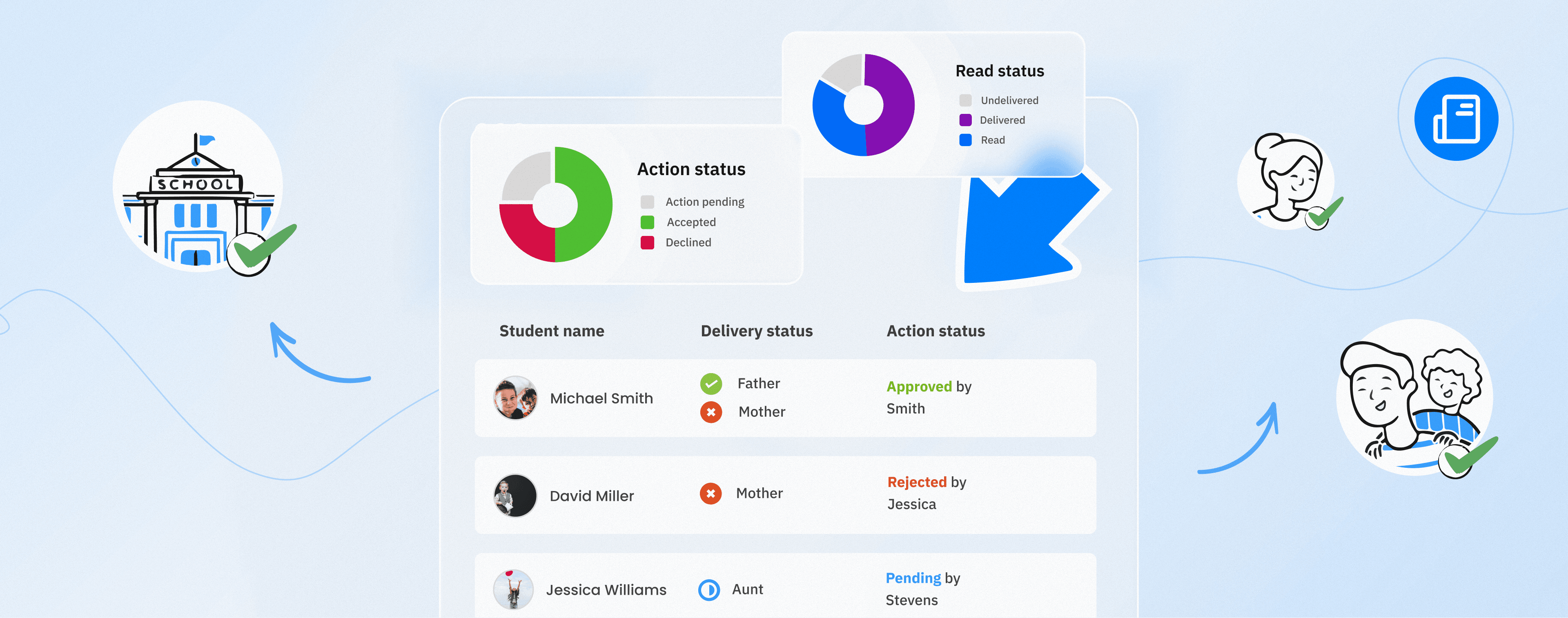
Field-trip and event consent is a classic paper chase. A one-tap Approval Request lets parents approve or reject in-app, secured with a PIN, while the school sees a live count of who has and has not responded. No printing, no collecting forms, no manual tallying.
3. Chasing parents who did not respond
The single biggest time sink is following up with non-responders. Smart Reminders nudge only the parents who have not acted, automatically, and move the message back to the top of their feed. Teachers stop combing lists to find the ten families who did not reply.
4. Distributing report cards and individual documents
Sending each child's report, certificate, or letter individually is hours of careful, error-prone work. Message Merge links to a data source, matches each file to the right student by ID, and delivers them individually at scale. One action instead of hundreds.
5. Handling routine parent questions
Repetitive questions ("when does the bus arrive?", "who do I ask about fees?") flood teachers when there is no structure. Chat Channels route questions to the right department: transport, admissions, accounts, wellbeing. The right person answers once, and classroom teachers stop being the default help desk.
6. Fee and payment reminders
Reminding parents about outstanding fees by hand is awkward and slow. With payment reminders, the follow-up goes automatically to the families who have not settled yet, and parents can act from the same message. Collection moves off teachers and admin staff entirely.
7. Attendance and absence follow-up
Absence notes that arrive by text, email, and verbal message all need logging. Structured Absence & Tardiness notes let parents submit a reason from predefined options (and upload a doctor's note) in a standard format, so attendance data is captured cleanly instead of reconstructed by hand.
How to reduce teacher workload without cutting standards
Reducing workload does not mean lowering expectations. It means removing the manual version of a task while keeping, or improving, the outcome. Three principles make that work:
| Principle | What it means in practice | The payoff |
|---|---|---|
| Consolidate, don't add | Replace WhatsApp, SMS, email and paper with one channel instead of bolting on another app | Teachers learn one tool, not five, and messages are sent once |
| Automate the chase | Let the platform remind non-responders and track actions | No manual list-combing, and higher response rates |
| Protect after-hours time | No shared personal numbers, and teachers control their availability | Less burnout and clearer work-life boundaries |
That last point matters for retention. Administrative overload and always-on messaging are among the most cited sources of teacher burnout, and schools increasingly connect teacher wellbeing to whether staff stay. Cutting admin is a workload win and a wellbeing one. For help choosing the tool itself, see our guide to picking the best school communication app.
Quick win: if you only automate one thing this term, automate non-responder follow-up. It is the task with the worst effort-to-value ratio, and Smart Reminders remove it almost entirely.
Why schools choose Schoolvoice to reduce teacher workload
Schoolvoice consolidates a school's fragmented communication tools into one secure app, which is what makes the time savings real rather than theoretical. Every task above runs from a single platform built for both schools and parents, with an interface simple enough that any parent can act in one tap.
The result is structure, not just messaging. Teachers do not just send a message; they get a result: an approval, an acknowledgement, a submitted absence reason, with no manual follow-up. Privacy is built in, so reducing workload never comes at the cost of oversight: no personal phone numbers are shared, AI moderation watches chat content, and message logs give management the visibility they need.
Hundreds of schools and thousands of parents across 16 countries use Schoolvoice as their official communication channel, and the platform was named to the Deloitte Technology Fast 500 in 2026. On average, schools reach about 86% of parents through Schoolvoice, and many reach 100%, so one official channel does what five fragmented ones cannot. It is also free for schools, so cutting teacher admin does not require a new budget line. You can review plans on our pricing page.
Want to give your teachers their week back? Book a demo and see how Schoolvoice automates the admin that is quietly eating teaching time.