What the Research Really Says About Parent Engagement: 10 Studies Every School Should Know (2026)

Every school leader senses that engaged parents make a difference. What is easy to forget is how much hard evidence sits behind that instinct. For more than fifty years, researchers have measured what happens to students when families are engaged and when schools communicate well with home, and the finding is remarkably consistent: it moves achievement, attendance, behavior, and whether a student stays enrolled at all.
This article walks through ten of the most important studies on the benefits of parent engagement in schools, in plain language, so you can point to the evidence, not just the instinct. Two themes run through all of them, and both matter for how you spend your time.
In this article you'll find:
- The landmark syntheses that settled whether parent engagement really works
- How big the effect is, and which kinds of engagement move the needle most
- Why school-to-home communication is the cheapest high-yield tool you have
- What all of it means for how your school engages families in 2026
The verdict is in: parent engagement works
Before arguing about how to engage parents, it helps to know the question of whether it works is closed. Four bodies of research put that beyond doubt.
1. Henderson & Mapp (2002): the landmark that settled it
The most-cited synthesis in the field, A New Wave of Evidence, reviewed 51 separate studies and reached one clear conclusion: there is a positive and consistent relationship between family engagement and student achievement, and it holds across every income level, race and ethnicity, and grade level. Engaged families do not just help already-advantaged students; children most at risk of falling behind gain the most.
2. Jeynes (2005, 2007): how big is the effect?
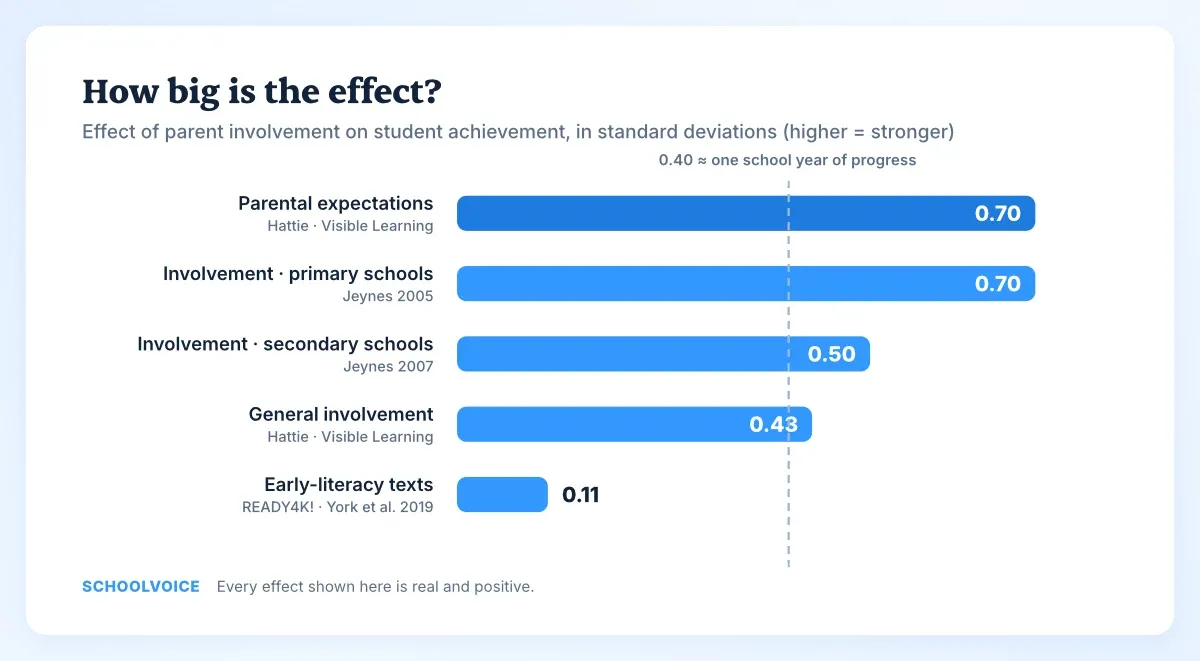
William Jeynes ran a series of meta-analyses to put a number on it. His 2005 analysis of urban elementary schools found parental involvement associated with achievement by roughly 0.7 of a standard deviation, holding for both minority and non-minority children, and for boys and girls alike. His 2007 study of secondary schools found a smaller but still substantial effect of about 0.5. In practical terms, that is the kind of gap that separates a struggling student from an average one.
3. Wilder (2014): a study of the studies
To cut through fifty years of individual findings, Wilder's meta-synthesis pooled nine separate meta-analyses. The relationship between parent involvement and achievement was positive no matter how you defined it. But the definition mattered enormously: the effect was strongest when involvement meant high parental expectations, and weakest when it meant helping with homework. That single finding should reshape what schools ask of parents.
4. Hattie's Visible Learning: expectations over surveillance
John Hattie's Visible Learning is the largest evidence base in education, synthesizing more than 1,500 meta-analyses. Its verdict on the home echoes Wilder's: parental expectations carry one of the strongest effects (around 0.70), while a "surveillance" style of involvement — checking, policing, monitoring — can actually be negative. The home factor that matters is talk and high expectations, not supervision.
What actually moves the needle
Once you accept that engagement works, the useful question is which kind, and whether it still counts as students get older. Two more studies answer that.
5. Epstein's framework: the map schools actually use
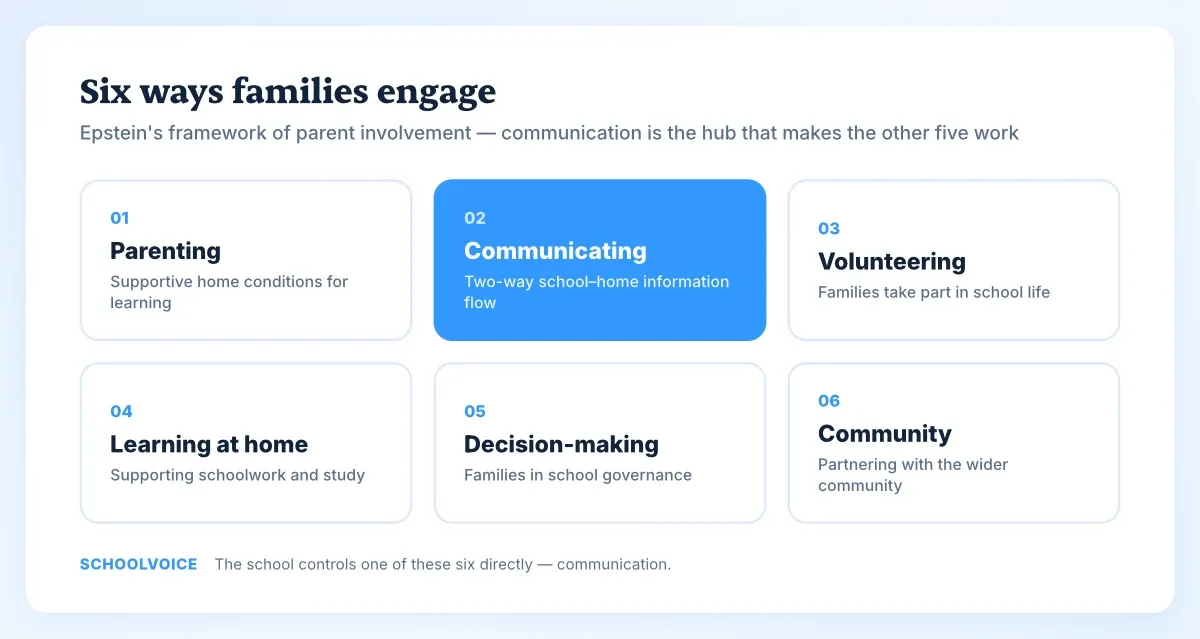
Joyce Epstein's theory of overlapping spheres of influence is the practical model most schools build their family-engagement plans around. It defines six types of involvement — parenting, communicating, volunteering, learning at home, decision-making, and collaborating with the community. Communicating sits at the center: it is the channel that makes the other five possible, and the one schools have the most direct control over.
6. Benner, Boyle & Sadler (2016): it still matters in high school
A common myth is that parent engagement fades in importance once students reach their teens. This longitudinal study of adolescents found the opposite. School-based involvement and parental expectations were significantly linked to students' cumulative high school grades and how far they went in education — and the benefit was largest for students from lower-income families. Engagement is not just an elementary-school project; it is an equity lever right through graduation.
The cheapest thing that works: communication
Here is where the research gets genuinely surprising. Some of the most rigorous studies in education — randomized controlled trials, the same design used to test medicines — show that simply communicating better with parents produces outsized results for almost no cost. Four experiments make the case.
7. Kraft & Rogers (2015): one sentence a week
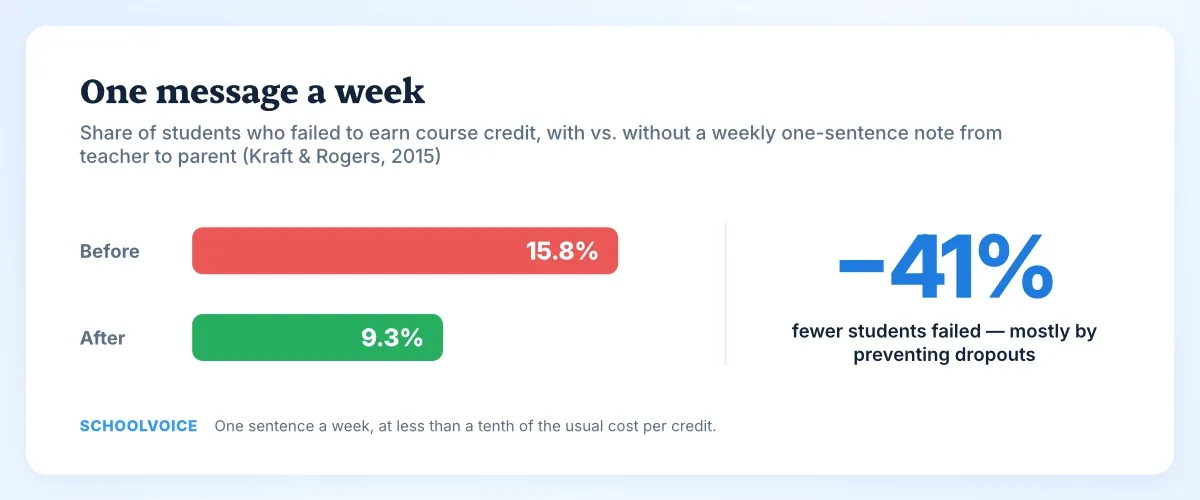
In a field experiment with high-school students in a credit-recovery program, teachers sent parents a single individualized sentence each week. That alone cut the share of students who failed to earn course credit from 15.8% to 9.3% — a 41% reduction — mostly by preventing drop-outs. The cost per additional credit earned was less than one-tenth of the district's usual cost.
8. Bergman: parents can't act on what they don't know
Peter Bergman's research on parent–school information gaps showed that when parents received regular text alerts about missing assignments and grades, students' achievement and engagement improved and course failures dropped. The mechanism is simple: parents want to help, but they often have no idea their child missed three assignments this week. Close the information gap and they act.
9. Rogers & Feller (2018): fixing what parents get wrong
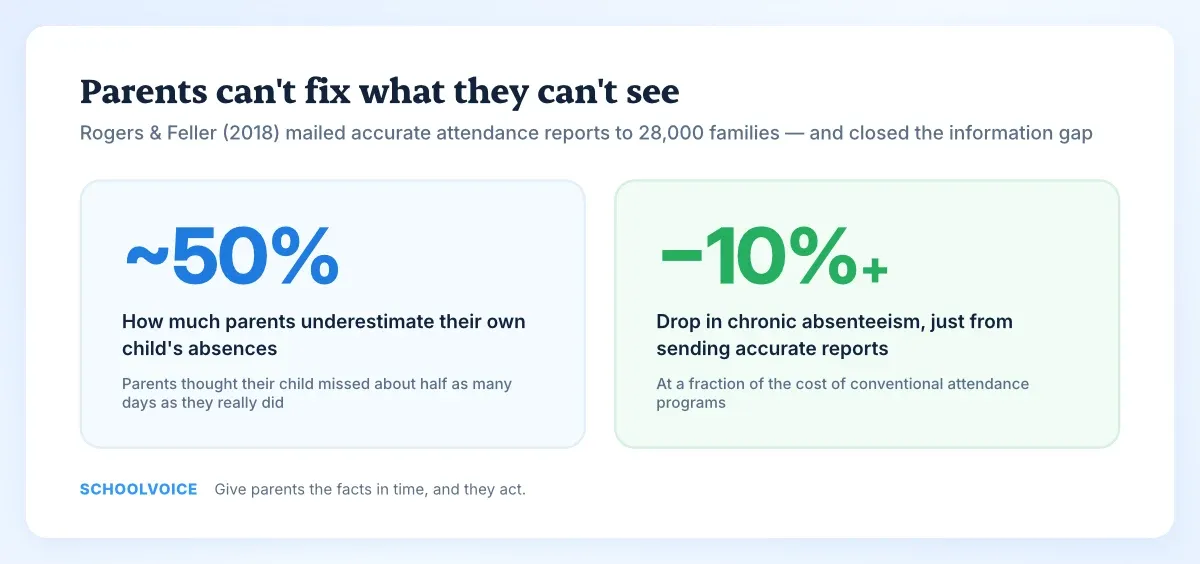
This large-scale experiment with 28,000 families tackled absenteeism. It turns out parents underestimate their own child's absences by about half. Simply mailing parents accurate, personalized attendance information cut chronic absenteeism by 10% or more — and did so at a fraction of the cost of conventional attendance programs. Better information beat almost everything else on the market.
10. York, Loeb & Doss (2019): it works from the very start
The READY4K! trial sent parents of preschoolers weekly text messages with small, concrete literacy tips. Children whose parents got the texts scored measurably higher on early-literacy assessments (an effect of about 0.11 standard deviations). Even before formal schooling begins, giving parents timely, actionable nudges changes what happens at home.
What this means for your school
Read together, ten studies point to a short, practical playbook:
- Raise expectations, don't just monitor. The strongest home effect comes from parents believing in and communicating high expectations — not from policing homework. Help parents do the former.
- Communication is the highest-return investment you can make. The one intervention that shows up again and again in randomized trials is timely, specific school-to-home communication. It is cheap, it scales, and it works from preschool to graduation.
- Close the information gap. Parents act when they know — about a missed assignment, a slipping grade, a growing pattern of absences. Most fall behind simply because no one told them in time.
- Keep engaging through the teen years. The payoff does not fade, and it matters most for the families with the least.
The thread connecting the evidence is that engagement is not about events and volunteering hours; it is about a steady, two-way flow of information between school and home. That is exactly what a dedicated parent engagement platform is built to carry. Schoolvoice gives schools one official channel to reach every family — with actionable messages, read-and-action reports so you know a notice landed, private teacher-parent chat, and a fallback SMS for parents who are offline. On average, schools reach about 86% of their parents through Schoolvoice, and many reach 100%. It is the communication backbone the research keeps pointing to, and it is free for schools to start.
If you are also working on the practical side of this, our guide to parent engagement strategies that actually work turns this evidence into steps you can use this term.
Research terms used in this article
To make the studies above easier to follow, here is a plain-language explanation of the key research terms that come up throughout:
Standard deviation
A standard deviation measures how spread out results are around the average. When a study says a program had an effect of 0.70 of a standard deviation, it means the improvement was large compared with what is typical in education research. As a rough guide, researchers read effect sizes like this:
- 0.20 = a small effect
- 0.50 = a moderate to large effect
- 0.80 or more = a very large effect
So when studies point to effects between 0.50 and 0.70 for parent involvement, it tells us the impact is far from marginal — it ranks among the strongest evidence-based interventions in education.
Meta-analysis
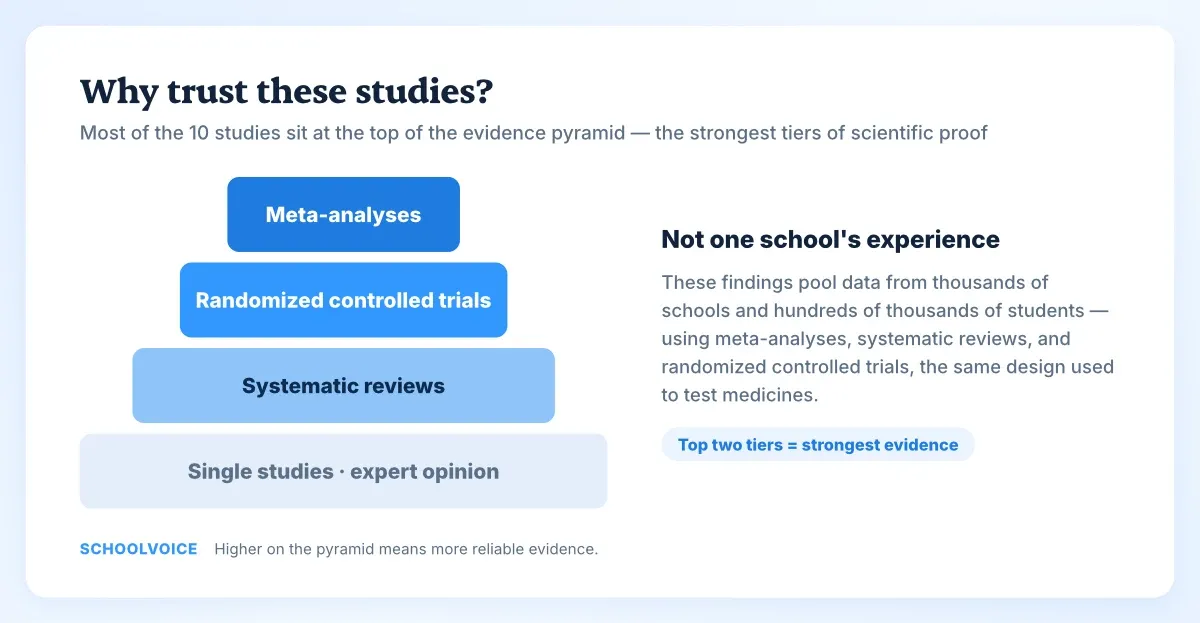
A meta-analysis is a research method that pools the results of many independent studies on the same question and analyzes them statistically to reach a more reliable conclusion. It sits among the highest levels of scientific evidence, because it draws on thousands of participants rather than a single study.
Systematic review
A systematic review gathers all the studies on a given topic using a rigorous, pre-defined method, assesses their quality, and summarizes the findings objectively. Unlike a traditional review, it uses clear criteria for choosing studies, which reduces bias and makes the conclusions more trustworthy.
Randomized controlled trial (RCT)
A randomized controlled trial is the gold standard for testing whether an intervention actually works. Participants are randomly split into two groups:
- a group that receives the intervention (for example, a new parent-communication program)
- a group that does not
The outcomes of the two groups are then compared to see whether the intervention is the real reason behind any improvement.
Effect size
Effect size measures how big an intervention's real impact is, not just whether the result is statistically significant. A study can be statistically significant yet have a weak practical effect. A large effect size means the intervention made a difference you can actually observe in the real world.
Statistical significance
Statistical significance means a study's results are unlikely to have happened by chance. But it is important to separate significance from effect size: a result can be statistically real yet have limited practical impact, which is why researchers always report the two together.
Why we relied on these studies
Most of the studies referenced in this article sit among the highest levels of scientific evidence in education, because they draw on meta-analyses, systematic reviews, or randomized controlled trials. That is why their conclusions do not rest on the experience of a single school, but on data gathered from thousands of schools and hundreds of thousands of students worldwide.
Want to see how consistent school-to-home communication looks at your school? Book a 20-minute Schoolvoice demo.