School Calling System: What Staff Personal Numbers Really Cost Your School
When a teacher calls a parent from their personal phone, the parent becomes familiar with their number and can easily recognise and answer their calls. But what happens when the teacher leaves the school and another teacher takes over their responsibilities?
The new teacher will call the parent from a different, unfamiliar number, which the parent may ignore, assuming it belongs to a stranger. As a result, something important may go unaddressed simply because the phone number has changed.
That’s one problem with using personal numbers for school communication. They also put staff and parent privacy at risk, tie important conversations to individual employees, and make it hard for school leaders to see what’s happening when someone is absent or leaves.
Giving every employee a work phone or SIM card is rarely practical, and the cost of managing extra devices and lines grows with every new hire, especially in larger schools.
The pressure is growing, too. In October 2026, some UAE schools introduced stricter guidelines for parent communication, including limits on calls and voice notes through informal messaging channels and set response hours.
With these new restrictions, what’s the alternative that keeps schools accessible to parents while protecting staff privacy and keeping control over communication?
What are the risks of calling parents from staff personal phones?
Personal phones can seem like a practical, easy way to reach parents, but the problems they cause often only show up over time, or when something happens that needs the school’s leadership to step in.
Here are the most common ones:
1. No record of the conversation
When staff call from personal phones, the school usually has no call records, no way of knowing whether a parent was actually contacted, and no reliable account of what was said.
If a concern comes up later, staff have to rely on memory, which makes misunderstandings harder to resolve.
2. Staff privacy and burnout
Teachers who share their personal numbers may feel they have to stay available after hours.
The line between work and home blurs, and without clear rules on when parents can call, constant contact becomes another source of stress and burnout.
3. Disruption when staff leave
Parents keep calling the number they know while the school introduces someone new.
If contact details and conversation history stay on the departing employee’s phone, their replacement starts without context, and the school may lose data that’s hard to replace.
A proper parent communication system keeps that history with the school, not with an individual, and gives authorised staff access based on their permissions.
4. Legal and compliance risks
Personal phones make it harder to keep records, protect sensitive information and meet legal obligations.
When parent data is stored on staff devices, the school can’t easily control who accesses it, retrieve it or delete it when needed.
Data protection, call recording and record-keeping requirements also differ from country to country. Schools should review the local regulations that apply to them before adopting any calling system, and make sure they have clear policies for managing data and access.
Overall, schools need tools that let them organise parent communication while keeping parent data confidential and records easy to access when needed.
Why don’t parents answer school calls?
Making the call is only half the job. Parents also need to recognise the number and pick up.
In Truecaller’s 2026 report, nearly 1 in 4 unknown calls in Egypt (22%) were flagged as spam in 2025, the highest in the Middle East and Africa, and users in Saudi Arabia and Jordan are seeing a rising volume of automated banking and insurance calls.
A separate Truecaller analysis of UAE data from January to November 2025 found that, although the UAE has one of the region’s lowest spam volumes, financial-sector calls make up almost 30% of reported unwanted calls.
When unfamiliar numbers are associated with spam, parents may be less likely to answer them, potentially missing important calls from their child’s school.
Calling from a mix of personal numbers makes it even harder for parents to spot an official school call.
For that reason, having an official school calling channel makes it easier for parents to recognise incoming calls, rather than having to identify unfamiliar personal numbers.
How missed calls affect school and family communication
A missed call might seem minor, but delays can affect important parts of school life, especially when the school needs to reach a parent quickly.
Unanswered calls hurt school-family communication in several ways:
- Attendance: Following up on student absences, including repeated absences, becomes slower.
- Student safety: It’s harder to reach parents when concerns arise.
- Emergencies: Families hear about urgent updates later than they should, which is why schools need backup channels for emergency alerts.
- Parent relationships: Trust fades when communication isn’t reliable.
That’s why managing calls isn’t just about making calls. It’s a core part of how schools and families stay connected.
What UAE and Saudi schools need to know about a school calling system
Choosing a school calling system in the MENA region, especially in the UAE or Saudi Arabia, means weighing local telecom rules, protecting parent and staff data, and meeting the needs of diverse parent communities.
1. WhatsApp calling isn’t right for every school
WhatsApp is widely used, but its voice calling isn’t available or suitable everywhere.
In the UAE, internet voice and video calling services must meet requirements set by the Telecommunications and Digital Government Regulatory Authority (TDRA), and some face restrictions.
That’s why schools shouldn’t rely on public messaging apps as their only way to talk to parents by voice.
A professional solution that fits the school’s needs and complies with local regulations is a safer choice.
If you’re weighing your options, see our guide to a secure WhatsApp alternative for schools.
2. Think carefully about recording
Where the system allows it, call recording and transcription help schools keep a record of important conversations and refer back to them when needed.
However, these features must be managed carefully to protect the privacy of everyone involved.
Before choosing a provider, make sure you understand the following:
- Which calls and related data are recorded?
- Who can access call recordings?
- How long are recordings retained?
- Is consent or prior notification required before recording calls?
Understanding these details helps schools choose a calling system that meets their needs while respecting privacy requirements.
3. Watch the cost of international calls
For parents abroad or on international numbers, regular calls can get expensive and may come with extra charges or restrictions.
A school-managed communication solution can be a more practical way to reach these families.
How to choose the right school communication solution for calls
Once you understand the challenges personal numbers create, the next step is choosing a system that helps your school manage calls in a more organised way.
Before you decide, check that it can answer these questions:
- Staff privacy: Can staff call parents without revealing their personal numbers?
- Recognisable caller identity: Can parents tell the call is from the school, and how does the provider handle spam labelling?
- Call records: Can authorised staff access the records they need for follow-ups?
- Data protection: Where is call data stored, and who can access it?
- Regional reliability: Does the service comply with local telecom regulations in the countries where your families live?
- Recording safeguards: Are recording settings, consent and notification handled properly?
- Continuity: Can communication carry on when staff leave or roles change?
Calling works best alongside your other channels.
For the bigger picture, see our guide to choosing a school communication app.
How can Schoolvoice Calls help your school?
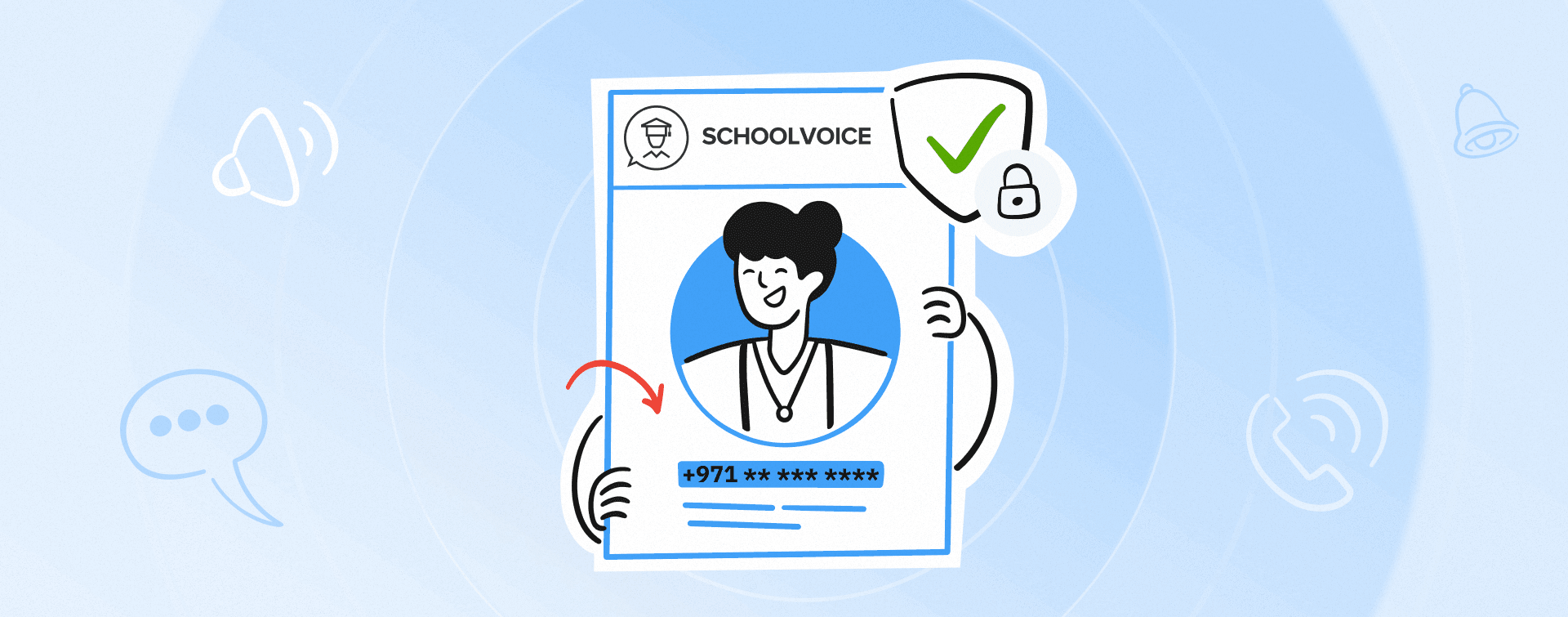
Schoolvoice Calls brings parent calling into the same school communication system your school already uses to talk to families, so staff never need to share their personal numbers.
Here’s what that gives your school:
- Protect staff privacy: Staff call parents without sharing their personal numbers, keeping work and personal life apart.
- Set working hours: Staff can set the hours they’re available to take parents’ calls.
- Keep visibility: Administrators can access call records, which makes follow-ups easier and communication more transparent.
- Control permissions: The school chooses who can make and receive calls.
- Stay in control: Calls live in the Schoolvoice platform, not on individual phones, so communication stays consistent when responsibilities change.
- Ensure transparency: Parents and teachers are informed at the start of each call that it’s recorded and accessible to the school.
- Plans for every school: Flexible voice calling plans designed for schools.
With Schoolvoice Calls, calling parents becomes a more organised, secure and school-managed part of your parent communication system.
Personal phones vs. generic calling apps vs. a school calling system
| What matters | Personal phones | Generic calling apps | Schoolvoice Calls |
|---|---|---|---|
| Staff privacy | Personal numbers are exposed | Depends on the app and setup | Staff can call through Schoolvoice without sharing personal numbers |
| School-managed communication | Limited | Depends on the provider | Calls are made through the school’s communication platform |
| Call records and follow-ups | Not managed by the school by default | Varies by provider | Administrators can access call records |
| Working hours | Managed individually | Depends on the app | Staff can set the hours they’re available to receive calls |
| Staff permissions | Difficult to manage centrally | Depends on the provider | Schools can control who is authorised to make and receive calls |
| Continuity when staff leave | Requires data transfer and a separate handover process | Depends on account ownership and setup | Calls aren’t tied to any one staff member’s number, and records stay with the school |
Personal phones and generic calling apps can help staff reach parents, but they rarely give a school the oversight and control it needs.
A school calling system makes communication more organised and consistent, while keeping it under the school’s management.
A better way to manage your school calls
Give your school more control over every call with Schoolvoice Calls, your school calling system.
See how your staff can call parents without sharing their personal numbers.