The Story Behind Schoolvoice: How a Personal Challenge Became a Platform for School-Parent Communication

Schoolvoice was not born in a meeting room. It did not start with a market analysis or a business plan on a whiteboard. It started with a feeling many parents know: the sense that, no matter how hard you try, you are not giving your children the time your relationship with them deserves.
I am Ali Bin Yahia. Before I was the founder of Schoolvoice, I was a father who traveled a lot. My work kept me moving between cities, and like many parents, I was trying to balance my responsibilities at work with my wish to be present in my children's lives.
What hurt was not the travel itself. It was what the travel made me miss.
I worked hard because I wanted to give my children a better life. But I also wanted to be part of the small details of their day. I never felt those two goals should be in conflict, yet in reality they often were.
That is where the journey began.
The messages that did not arrive in time
Back then, my children's school relied on text messages to keep parents updated.
The problem was not the messages themselves. It was the way they worked.
They were very short, and they arrived among dozens of others: bank alerts, telecom notices, daily reminders. I would often put off reading them until the weekend, and sometimes I forgot them completely. When I finally came back to them, I would discover I had missed something important, or a date I should have known.
Over time, I began to notice a second problem.
The messages were so brief that it was hard to understand what was actually being asked. Information reached me, but without context, and without any sign of what the school expected me to do as a parent.
Later, I understood why.
Text messages were a heavy financial burden on schools. Some were spending between 40,000 and 180,000 dirhams a year on SMS alone. And when every message costs money, it is natural for a school to make each one as short as possible, even at the expense of clarity.
Then I discovered another challenge, one that many parents never see.
Many schools in the UAE, and international schools, need to send each message in both Arabic and English, and to the father and the mother at the same time. So a single message can go out four times. That multiplies the cost, and it pushes schools to send fewer messages and stick to the essentials only.
And we, the parents, were the ones losing the full picture.
When a text did not arrive, a paper note came home with the child instead.
But what happens when the parent is traveling? Or the child is young and leaves the note in a bag? Or it disappears somewhere between the textbooks?
Each detail looked small on its own. But they kept repeating, until I became convinced the problem was not the people. It was the method itself.
In that moment I told myself: there has to be a better way.
When the problem became personal
Before I founded Schoolvoice, I worked in user experience design, a field that changes the way you look at the world.
You start noticing the details others walk past. You keep asking: why does this work this way? Could it be simpler? Is the problem the user, or the design?
I found myself thinking like that about almost everything, from the apps I used to the everyday services around me.
And when I looked at the relationship between schools and parents, I saw that the problem was not the school, and it was not the family either.
Schools wanted to reach parents. Parents wanted to follow their children. But the channel meant to connect the two sides was not doing its job.
That is when it became clear: the real problem was not a lack of care. It was weak communication tools.
And once I was sure of that, I could no longer ignore it. I started thinking about the solution.
From an idea to a first step
I did not start by building a complete product, and I did not write a long business plan. I started with something much simpler.
I sketched high-fidelity prototypes of what I imagined the solution could look like, and I took them to a few schools I knew.
My question was direct: if we build this exactly as you see it today, would you use it? And would you be willing to pay for it?
I was not looking for a compliment. I wanted an honest answer. And the answer I heard, more than once, was: yes. This would solve a real problem for us.
That was enough to make me move forward.
But I also believed that building a company does not start with assumptions. It starts with a deep understanding of the problem. So I kept talking to schools, and I listened more than I spoke. The deeper I went, the more I realized the problem was far bigger than I had imagined.
Two sides, one problem
At first I thought the problem belonged to parents only. But over time I realized the school was struggling just as much.
Schools were relying on a mix of text messages, paper notes, emails, and sometimes WhatsApp groups. Each tool solved part of the problem and created a new one.
SMS was expensive. Paper got lost or arrived late. Not everyone read email. And WhatsApp groups quickly turned into a flood of messages that was hard to follow or search.
But the tools were not the only issue. Even when a message reached a parent, the same question remained: what does the school want from me now?
Often the message told me what had happened, but not the next step. Was approval needed? Did I have to pay a fee? Should I sign a form? Or was it just a notice to read?
And when an action was needed, another journey began: download a form, print it, sign it, scan it, then send it back. The whole process felt like it had been designed for a different era.
On the other side, the school lived the same struggle. Staff chasing parents by phone. Repeated reminders. Paper slips coming back so an administrator could re-enter the data into the system by hand. So much work, most of which could disappear if the communication tools were better.
Then there was another problem I noticed as a parent. I kept getting messages that ended with a line like: "if you have already completed this, please ignore this message."
And each time I wondered: is this message really meant for me? Or was it sent to everyone? And is there still something I am supposed to do?
When that experience repeats often enough, a parent starts treating most messages the same way: ignoring them. Not because they do not care, but because they can no longer tell which messages need action and which are just a general reminder.
On top of all this comes a challenge many international schools live with: different languages. A parent might read only Arabic, or only English, while the school needs to reach everyone with the same clarity.
At that point the picture was clear to me. The problem was not that the school did not want to reach the family, and it was not that the family did not care. The problem was that the bridge between them no longer fit the way we live and communicate today.
And that was the bridge we decided to rebuild.
We were not building a messaging app
From the start, we knew what we did not want to build. We did not want another version of WhatsApp, and we were not looking for a prettier way to send text messages.
Our goal was completely different. We wanted a platform designed from the ground up for school communication, one that addressed the daily problems facing the school and the parent at the same time.
And there was one principle we never compromised on throughout the design: if a parent needs an explanation of how to use the app, then we have not designed it properly.
So we focused on making every step clear, every action intuitive, and every message lead directly to what should be done.
What helped us most was that our team did not look at the problem from the outside. Among us are parents, and among us are husbands of teachers. Many of the problems we were trying to solve, we were living ourselves.
That is why the features we built were not abstract ideas. They were solutions to situations we knew up close.
Every feature started from a real problem
People sometimes ask us: how do you choose what to build in Schoolvoice?
The answer is simple. We do not start from a list of features we want to add. We start from a problem we hear, an experience we live, or a moment when we feel there is a better way to do something.
Almost every part of Schoolvoice began that way. We did not build a feature because the market wanted "something new," but because a school, a teacher, or a parent faced a real problem and needed a simpler solution.
Actionable Messages: because I did not just want to read a message, I wanted to know what to do
This was one of the first problems we set out to solve. When a message reached me from the school, the problem was not that I did not read it. The problem was that, after reading it, I would ask myself: what do I do now?
Do I need to approve something? Do I have to pay? Is it just a read receipt? Is there a deadline?
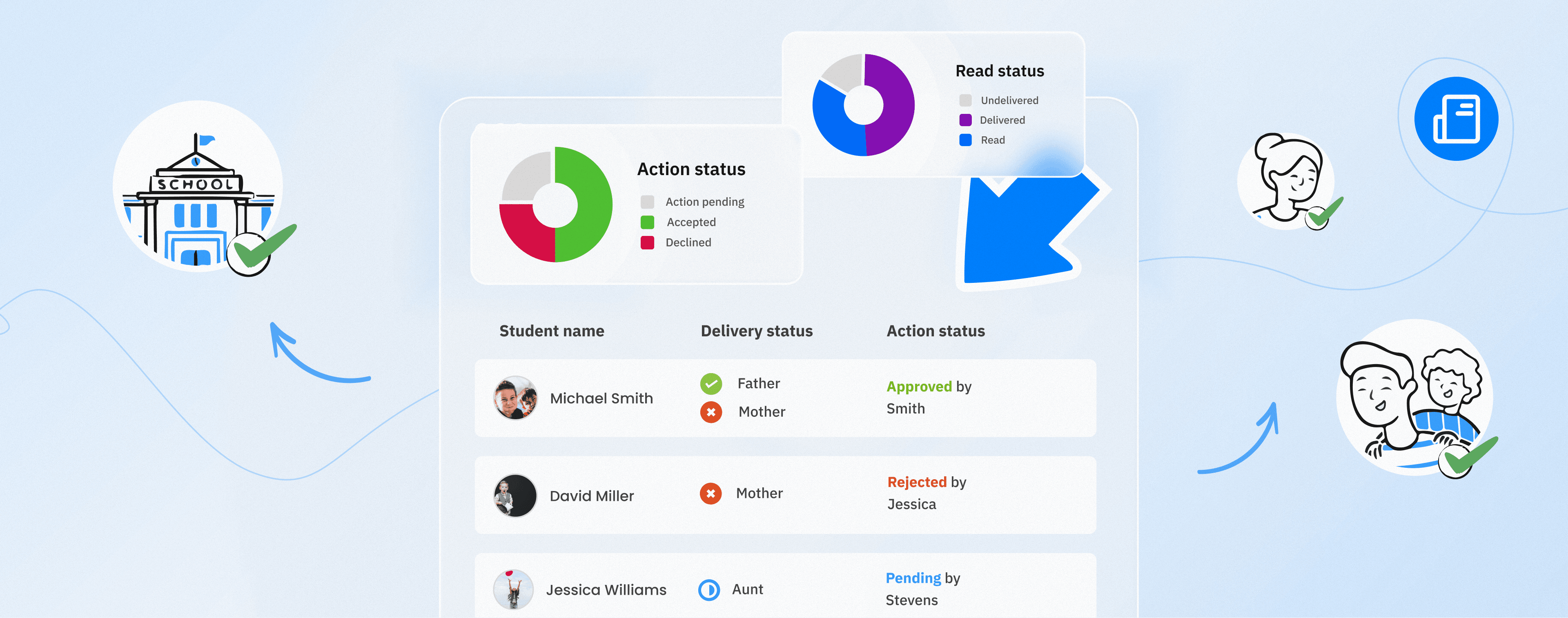
So we built the idea of Actionable Messages. A message is no longer just information reaching a parent. It becomes the starting point of a clear action.
The required action appears inside the message itself: Read, Approve, Pay, Acknowledge, or whatever the school needs. Instead of moving between email, forms, and different links, a parent can do what is asked right there, in the same place.
I noticed something in myself: the less personalized a message was, the less I engaged with it, because it felt aimed at everyone and not at me specifically. So we made personalization a core part of every message.
Even the small details mattered to us. If I have two children in the same school, I do not want a message to arrive and leave me wondering which child you mean. So we designed the experience to make each student's information clear. And if a message carries a photo or an update about one of my children, I know instantly which one.
We also added importance flags and a Smart Reminder, so reminders never become a nuisance for everyone. The parent who has already acted does not need more messages, and the one who has not acted yet is the only one who gets a nudge.
The idea is simple: good communication is not about sending more messages. It is about sending the right message to the right person at the right time.
Stories: because I wanted to know more than "how was your day?"
There is a question most parents ask their children every day: "how was your day at school?" And the answer is usually: "good." Not because the child has nothing to say, but because it is hard to remember every detail of a full day, or hard to put it into words.
That is where the idea of Stories came from. Schools wanted to share with families what happens inside and outside the classroom. But there was an important challenge: a parent wants to see their child's life at school, without those moments being posted in a public space.
We did not need a new social network. We needed a safe, private space that reaches only the people concerned. So we designed Stories to be a private environment where teachers share moments of learning and activity with the relevant parents only.
And the goal was never the photos themselves. It was to change the kind of conversation at home. Instead of "how was your day?" it might become: "I saw you were in the lab today, what did you learn?" or "I saw you drawing in the activity, tell me about the idea."
These small details build a bridge between the child's world at school and the family's world at home. They also give parents a chance to see the great effort teachers put in every day, effort that sometimes passes without anyone noticing.
From the outside, a school can feel like a closed place. Stories opens a small window onto what happens inside.
The Emergency Alert: the feature we hoped we would never need
Some ideas are not born from analysis or interviews. They are born from a moment you never forget.
I was at a school presenting Schoolvoice, and during the visit a student had an accident. In seconds, the atmosphere turned into an emergency.
The first question was: how do we reach the parent as fast as possible?
The team started calling. But some of the numbers were old and out of date. And when they found a working number, no one answered, despite repeated attempts.
At the same time, the nurse faced a harder question: should she give the child a certain medicine? Or was he allergic to it? No one had the answer, in a moment when every second mattered.
Standing there, I thought: the student data is already with the school, so why is there not one fast, direct way to reach all of a student's guardians at once?
That is where the idea of the Emergency Alert was born. One tap from the school reaches all of a student's guardians at the same moment, on an official, trusted channel. And even if the phones are on silent, the alert appears and is heard.
I always hope no school will ever need this feature. But in the moments when every second matters, the tool has to be ready.
Schoolvoice Live: because distance should not cost a parent the moments that matter
One of the things I felt most as a traveling parent is that some moments cannot be replaced. A school event, a presentation your child gives, an end-of-year celebration. A small moment that might look ordinary to others, but means everything to a mother or a father.
I knew that feeling well: to be far away, and to wish only that you could be there.
That is where Schoolvoice Live came from. Before it, schools often relied on sending video-meeting links, or using generic tools that were never built for school communication. The school had to send the link, the parent had to find it among many messages, then remember the time, then join the right platform. At every step, there was a chance someone would miss the moment.
And honestly, I never liked the idea of school WhatsApp groups. Not because they do not work, but because they were not designed for this. Messages pile up, important information disappears among dozens of chats, and every year a new group starts from scratch.
In Schoolvoice, the idea is simpler. The school selects the classes or families concerned, the broadcast begins, and the notification reaches the right parent. One tap, and you are part of the moment. No lost links, no searching through messages, and no feeling that you missed something important in your child's life.
Voice notes and translation: because communication should not have a barrier
We learned from schools and parents that communication is not always easier when it is written. Some parents prefer to speak, and some teachers need to explain a whole idea that a short sentence cannot hold. Schools today are also more diverse, and the language of the school may not be the first language of every family.
So we added voice notes and in-chat translation. The idea was not to add technology for its own sake, but to remove the barriers that make communication harder than it should be. A parent who finds writing difficult can speak, and a family that speaks a different language can understand the message in their own.
But we also learned a funny lesson from teachers: they told us some voice notes were arriving very long. So we set a maximum length of 5 minutes, and added playback speed control, so voice stays an effective tool and not an extra burden on a teacher's time.
Secure Calls: when a minute is better than ten messages
Over time, we discovered that some conversations do not need more messages. They need one minute of talking. It might be a note from a teacher, a question from a parent, or a quick clarification that saves a long chain of messages.
But there is a basic problem in traditional communication: a teacher should not have to share a personal number, and a parent should not have to hunt for several numbers or reach out through unofficial channels.
That is where the idea of secure Voice Calls inside Schoolvoice came from. We want human communication to exist, but within a frame that protects the privacy of the school, the teacher, and the family. Because technology should not replace the relationship between people. It should make it easier.
More than a company: a mark we want to leave behind
Honestly, Schoolvoice did not start because I was simply looking to found a new company. It started because it was a real problem that affected my life as a father. I wanted a better way to communicate with my children's school, and then I discovered that thousands of families and schools face the same problem.
But over time it became bigger than a product. It became a question: what mark do we want to leave behind?
I believe the best companies do not start from a desire to build a company, but from a desire to solve an important problem and offer real value to people.
I also wanted my children, and the young people of our region, to see that great ideas do not always have to come from somewhere else. They can start from a personal experience, from an everyday problem, and from someone who decided not to just complain, but to try to find a solution.
The road was not easy
There is a side of founder stories that does not show up often: the road was not easy.
In the beginning, we had to prove ourselves. Some schools rejected the idea because we were a new company without a long history. And that is natural, because schools do not change their tools easily, since any change affects teachers, staff, and parents all at once.
Even when a school saw the value of the solution, the next challenge was changing habits. Some teachers were used to certain ways of communicating, and some parents needed time to get used to a new way.
But we learned something important: change does not happen just because you build a good product. It happens when you listen, understand, and prove the value step by step.
So we did not try to force a new way. We listened, we improved, we tried, then we came back and listened again. Every note from a school, a teacher, or a parent made Schoolvoice better, and every challenge we faced helped us build a platform closer to the reality we want to improve.
From a personal idea to a platform serving schools and families
The idea of Schoolvoice may have started from a personal experience I lived as a parent, but it was never a one-person project. Ideas can start with a person, but they only become real with a team that believes in them.
From the very first days, my co-founder Eyad Salamin stood beside me, and helped turn the vision into real, dependable technology. And with him, a team helped turn the idea from a concept into a real product: from experience design, to building the technology, to working with schools and families every day. Everyone on the team added a part of this journey.
The best part is that many of the people who work with us understand the problem from the inside. Among us are parents, and among us are people with a direct connection to education. So when we build a new feature, we do not only ask "does it work?" We ask: "will it make someone's life easier?" Will it save a teacher's time? Will it help a parent follow their child better? Will it bring the school closer to the family?
These are the questions that guide us.
Where are we today?
Today, Schoolvoice has become an official channel for communication between schools and families in 16 countries, used by schools from different markets and cultures.
But for us, the numbers are not the whole story. The real story is every time an important message arrives at the right moment. Every time a parent learns something they would have known too late. Every time a teacher saves time they would have spent chasing replies by hand. Every time a parent feels closer to their child's life at school.
That is the value we want to build.
Why we keep building Schoolvoice
Because the problem we started from has not disappeared. It has become more important.
Schools today have more ways to communicate, but they need a better way to organize that communication. Families today have a greater desire to take part, but they need clear information that reaches them at the right time. And students need a stronger relationship between the two most important worlds in their lives: home and school.
We believe communication is not just sending a notification. Real communication means the information reaches the right person, at the right time, in a way that helps them act. That is the difference between a message that is sent, and a message that makes a difference.
We are still at the beginning of the journey
When I look back at the start of Schoolvoice, I remember that everything began with a simple question: why is there no better way to communicate between the school and the family?
That question led us to build a platform, but it also led us to a deeper understanding of the problem. We learned that technology alone is not enough, design alone is not enough, and the product alone is not enough. What makes the difference is understanding the human being we want to help.
The parent who wants to be close to their children. The teacher who wants to focus on teaching instead of paperwork. The school that wants to build a stronger relationship with its community.
For all of them, we build Schoolvoice.
If your school is looking for a better way to reach families
If your school still relies on scattered messages, paper notes, or tools that never give you the full picture of parent engagement, we would be glad to share what we have learned and what we have built.
A short session of 20 minutes may be enough for you to see how communication between the school and the family can become simpler and more effective.
Book a Schoolvoice demo, and let us show you what school communication can look like when it is designed around human needs first.