Agentic AI in K-12 School Operations: What Actually Changes
Agentic AI is the phrase every education vendor is using this year. Stripped of the marketing, it describes software that does not wait to be asked: it decides what to do next, takes the action, and reports back.
For a school leader the useful question is not whether this is impressive. It is which parts are working in schools today, which parts are still a demo, and what you should ask before letting any of it near your students' data.
This guide covers all three, and ends with the questions worth putting to a vendor before you sign anything.
In this article
- What agentic AI is, and how it differs from the AI your school already uses
- Where it is genuinely working in school operations today
- What it is doing in classrooms, and how far that has actually got
- What it still cannot do, despite the claims
- The governance questions to ask any vendor
- Where school-parent communication fits
- A practical checklist for school leaders
What is agentic AI, and how is it different?
Most AI already in schools is reactive. You ask it something, it answers. It has no memory of your goal and takes no action on its own.
Agentic AI is built around a goal instead of a prompt. Give it an outcome, and it plans the steps, uses tools, checks its own progress and adapts when something changes.
The practical difference between them is simple:
Who does the work between the question and the result?
| Traditional AI and automation | Agentic AI | |
|---|---|---|
| Trigger | You ask, or a rule fires | You set a goal |
| Scope | One task | A sequence of tasks |
| When something changes | It fails or does the wrong thing | It adapts and retries |
| Tools | Works inside one system | Acts across several systems |
| Your role | You drive every step | You set the goal and review the outcome |
| The risk | It does nothing useful | It acts without you noticing |
That last row is the one school leaders should sit with. The capability that makes agentic AI valuable is the same capability that makes governance non-negotiable.
Where agentic AI is already working in school operations
These are the areas where schools are seeing real results now, rather than in a roadmap.
Administrative load
Timetable conflicts, attendance follow-up, form chasing, routine record updates. This is the clearest early win because the tasks are repetitive, rule-heavy and low-risk when they go wrong.
Vendors quote time savings in the 20% to 30% range for these tasks. Treat those figures as vendor estimates rather than independent research, and ask any supplier to show you the measurement behind the number.
Enrolment and scheduling
Applications, document collection, class allocation and timetable building. Agentic tools handle the back and forth of chasing missing documents, which is where most admissions time actually goes.
Data and early warning
Pulling attendance, behaviour and assessment data together to flag students whose pattern is changing. The value is not the prediction, it is that a human looks at the right name in week three instead of week twelve.
Our guide to student retention in schools covers the warning signs that tend to appear long before a family withdraws.
Routine communication
Drafting the newsletter, translating a notice, summarising a long thread, preparing the first version of a parent update. The teacher stays the author. The blank page disappears.
If reducing staff workload is your main driver, the admin tasks technology can automate is a more grounded place to start than an AI strategy.
What agentic AI is doing in classrooms
Classroom applications get the most attention and are the least mature. Worth understanding, worth being sceptical about.
Tutoring and practice
AI tutors that work through problems with a student, adapt to their level and stay available outside school hours. Genuinely useful for practice and revision. Not a substitute for a teacher, and the evidence base is still thin.
Adaptive learning paths
Platforms that adjust what a student sees next based on how they are performing. This is the oldest idea in the list and predates agentic AI by two decades.
Lesson and curriculum support
Drafting lesson plans, differentiating a worksheet five ways, generating practice questions aligned to a curriculum. Teachers report this saves real preparation time, provided a subject specialist checks the output.
Our practical guide to using AI assistants for teacher workload covers what this looks like day to day.
What agentic AI still cannot do
Most articles on this topic skip this section. It is the part that protects your budget.
Be accountable
If an agent sends the wrong message to 400 families, the school answers for it, not the tool.
Understand your school's context
It does not know which family is mid-crisis, or which parent complained last term.
Guarantee accuracy
Models still state wrong things confidently, and an agent will act on them.
Work reliably across your systems
Most schools run several platforms that do not share data cleanly.
Replace judgement in safeguarding
Flagging a pattern is useful. Deciding what it means is not automatable.
Here is a practical test.
If the task would need a manager's approval when a human did it, it needs one when an agent does it.
The questions to ask before you buy
Security and data protection are the most common concerns school leaders raise about AI, and they are rarely answered properly in a sales meeting. These are the questions that get past the demo.
Where does our data go, and what is it used for?
Ask plainly:
- Does student data leave the country or the region?
- Which sub-processors can access it?
- Is any of it used to train a model?
- How long is it retained?
- What happens to it when the contract ends?
Then ask for the answers in writing.
What can the agent actually do without a human?
There is a large difference between drafting a message and sending one. Ask for the exact list of actions it can take unsupervised, and make sure sending to families is not on it by default.
Can we see what it did?
Your school needs a log showing:
- What action the agent took
- When it took it
- On whose behalf
- What data it read
- What outcome it reached
- Whether a staff member intervened or stopped it
If a vendor cannot produce a clear audit trail, the tool is not ready for a school.
Who approves an action before a parent sees it?
Anything reaching families in the school's name should pass a human first. Ask how approval works, who holds it, and what happens when that person is away.
Can we switch it off?
Per-feature and per-staff, without losing the rest of the platform. If AI is all-or-nothing, you have no way to pilot it safely.
What happens when it is wrong?
Ask about:
- Message recall
- Correcting the information
- Notifying the families affected
- The escalation route
- Who reviews the incident
- How recurrence is prevented
A message you cannot withdraw or correct is a message you should not have automated.
Where school-parent communication fits
Whatever agentic AI a school adopts, families see the results through the communication channel. That is where an automated action stops being internal and becomes something a parent reads.
So the governance questions above land hardest on that layer. Before letting anything automated speak to families, a school needs three things in place.
Approval before sending
An authorised member of staff reviews anything going out in the school's name before it reaches families.
A complete record
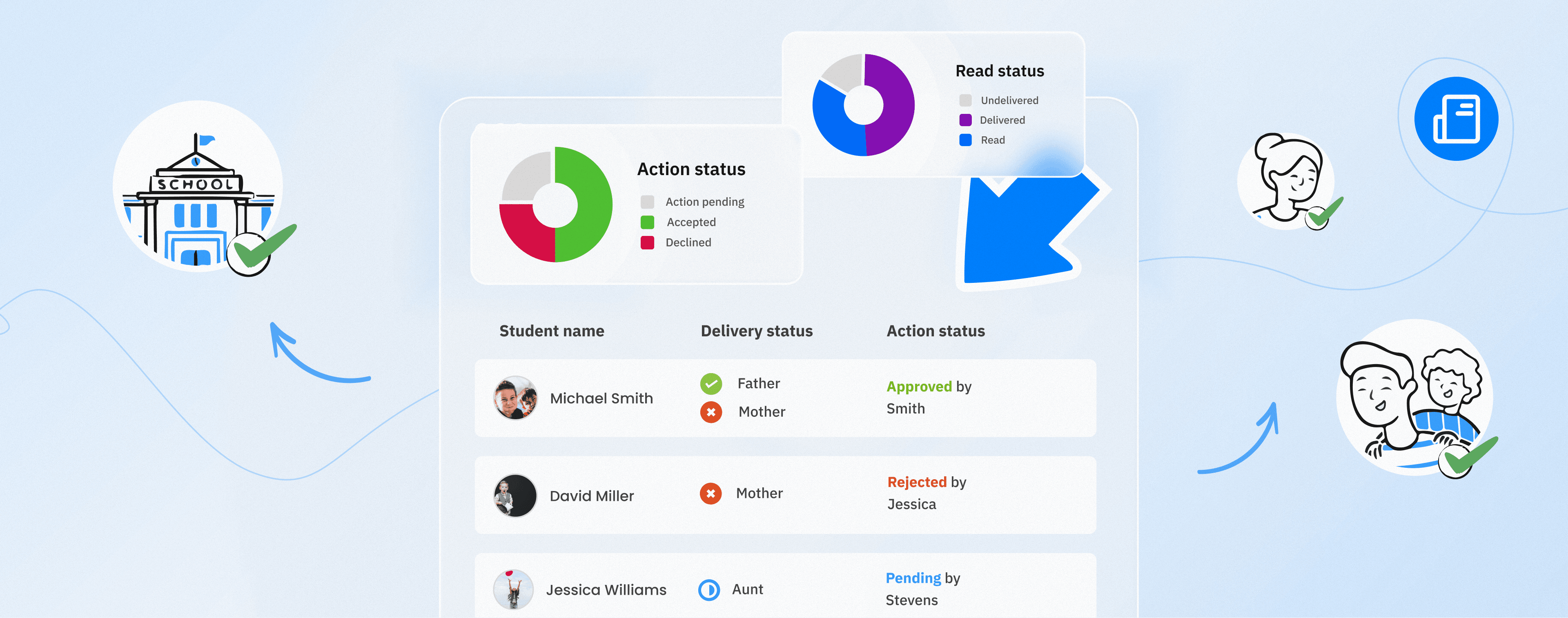
Every message logged with recipient, timestamp, delivery status and who or what sent it, exportable when someone asks.
A way to undo
Recall a message that should not have gone, while keeping a record showing it was sent and then withdrawn, rather than pretending it never existed.
Schools in Abu Dhabi have a regulatory version of this already: our ADEK Parent Engagement Policy compliance checklist covers the clause requiring a record of all written communication with parents.
Schoolvoice is the communication layer rather than an AI platform. It uses AI where it genuinely helps: message translation, content moderation and reporting.
The design principle is that a human stays between an automated action and a family. So Schoolvoice provides:
- An approval workflow before publishing
- Independent permissions per staff member
- Message recall
- An exportable record of everything sent
A checklist for school leaders
If you are being asked to approve an AI purchase this year, work through this before the budget conversation.
| Check | What good looks like |
|---|---|
| Problem definition | A named process that is slow today, with a number attached |
| Scope of autonomy | A written list of what the agent may do unsupervised |
| Data location | Confirmed in writing, including sub-processors |
| Model training | Explicit confirmation that student data is not used for training |
| Audit trail | Exportable log of agent actions, not just outputs |
| Human approval | Required for anything reaching families |
| Off switch | Per feature and per staff member |
| Error handling | Recall, correction and a named escalation route |
| Pilot | One department, one term, agreed success measures |
| Staff training | Budgeted, not assumed |
Schools that adopt this well tend to start narrow. One process, one term, one clear measure, then expand once staff trust what they are seeing.
Where this leaves school leaders
Agentic AI is real, and the operational gains in admin, enrolment and early warning are already worth having. The classroom claims are further from delivery than the marketing suggests.
The schools that will benefit are not the ones that move fastest. They are the ones that decide in advance what an automated system is allowed to do without asking, and can prove afterwards what it did.
Start with the governance questions, not the feature list. The vendors worth working with will have good answers ready.
If you want to see what an auditable parent communication record looks like in practice, book a walkthrough and we will show you the reporting side.
Further reading
- AI Agents Reveal New Tech Possibilities in K-12 Education, EdTech Magazine
- The Future of AI in K-12 Education: What School Leaders Need to Know, Georgia School Boards Association
- What does the future of AI in education look like?, ASU Prep Global